Product
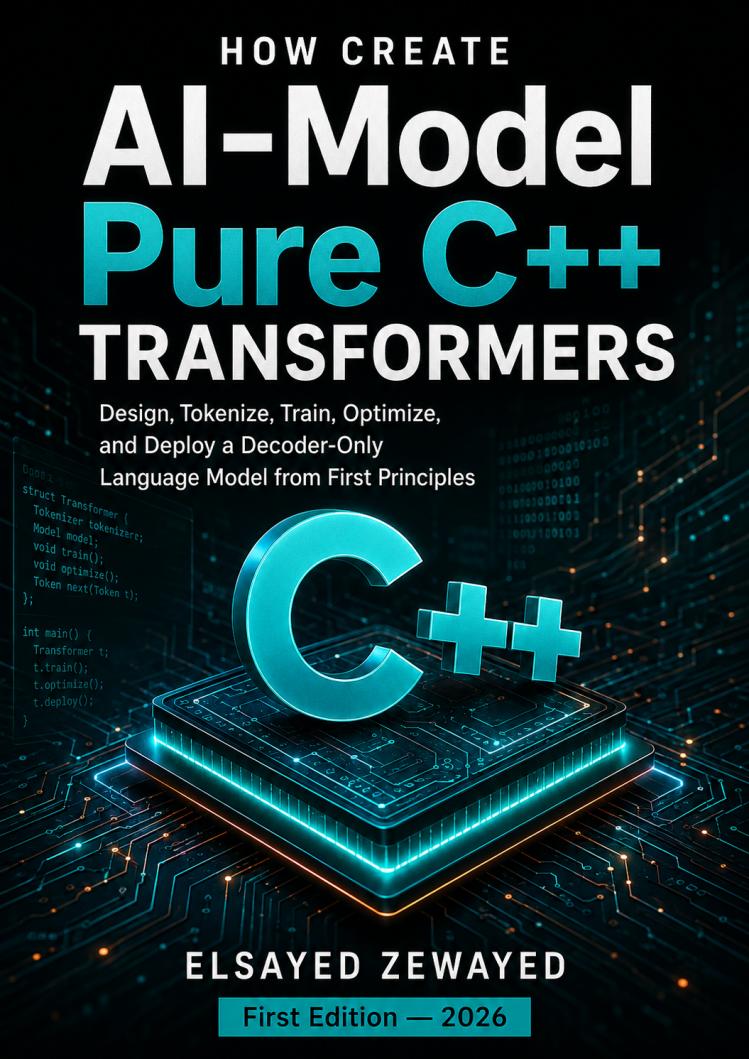
HOW CREATE AI-Model Pure C++ TRANSFORMERS
Build a Transformer. Understand Every Layer. Train It. Run It. Own the Knowledge. What if you could build a real Transformer language model in C++, understand every important component behind it, train it on your own data, optimize its performance, save and resume its state, and finally interact with it through a working inference and chat pipeline? HOW CREATE AI-Model Pure C++ TRANSFORMERS was written for developers, engineers, and serious AI learners who want to move beyond high-level demonstr
$129.99
Secure checkout · Digital delivery to your account after payment.
- File format
- application/pdf
- File size
- 5.3 MB
- License
- See product terms
- Version
- —
Details
About this product
Build a Transformer. Understand Every Layer. Train It. Run It. Own the Knowledge.
What if you could build a real Transformer language model in C++, understand every important component behind it, train it on your own data, optimize its performance, save and resume its state, and finally interact with it through a working inference and chat pipeline?HOW CREATE AI-Model Pure C++ TRANSFORMERS was written for developers, engineers, and serious AI learners who want to move beyond high-level demonstrations and discover how modern Transformer language models actually work from the inside.
This is not a book about calling an AI API.
It is not a collection of Python notebooks hiding the engineering behind frameworks.
And it is not a theoretical discussion filled with equations that are never connected to working software.
This book takes a different approach.
You will build a decoder-only Transformer language model step by step in modern C++, beginning with the fundamental architecture and continuing through tokenization, datasets, training, optimization, checkpointing, inference, text generation, chat, and production-oriented execution.
The objective is simple:
By the end of the journey, you should understand not only how to use a Transformer, but how to engineer one.
Start from First Principles
A Transformer does not understand sentences, paragraphs, or ideas directly. It processes numerical tensors.
Before building a large model, you need to understand the path:
Text → Tokens → Embeddings → Transformer Blocks → Logits → Probabilities → Next Token
The book develops this pipeline gradually so that every new component has a clear purpose.
You will explore token embeddings, model dimensions, residual connections, normalization, attention, feed-forward networks, causal masking, positional information, output projections, and autoregressive generation.
Instead of treating the Transformer as a mysterious black box, the architecture is separated into understandable engineering components.
Who Is This Book For?
This book is designed for readers who already know the fundamentals of programming and want to move into deeper AI engineering.
It is especially useful for:
C++ developers who want to enter machine learning and Transformer development.
AI developers who know Python but want to understand lower-level implementation and runtime control.
Software engineers who want to understand what happens beneath high-level AI frameworks.
Students and researchers who want to connect Transformer mathematics with executable software.
Independent developers who want to experiment with their own language models instead of relying entirely on external AI services.
You do not need to be a Transformer researcher before opening the book.
But you should be willing to build, test, debug, and understand.
Stop Treating the Transformer as a Black Box
Modern AI can appear impossibly complicated when viewed as one enormous system.
It becomes much more understandable when it is decomposed into tensors, projections, attention scores, normalization, residual paths, feed-forward transformations, optimization steps, and generation loops.
That is the philosophy behind this book.
You will not simply read about Transformers.
You will follow the architecture.
You will calculate it.
You will code it.
You will build it.
You will train it.
You will debug it.
And finally, you will run it.
If your goal is to understand how a decoder-only language model can be created from first principles using Pure C++ engineering, this book was written for you.
Build the model. Understand the system. Take control of the technology.